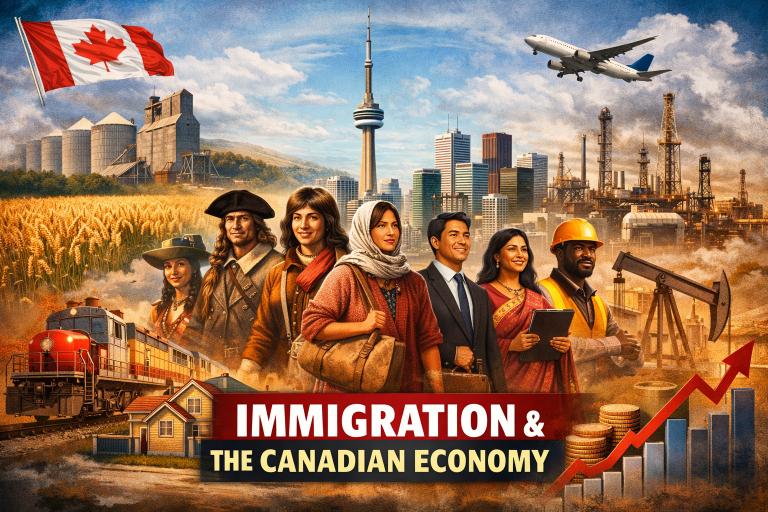
Canada is not merely a country that receives immigrants. It is a political economy constructed through immigration. From the founding of Québec by Samuel de Champlain in 1608 to contemporary adjustments in admission targets, population inflows have functioned as an explicit instrument of economic design. Immigration has enlarged markets, populated frontiers, supplied labor to factories and resource projects, and diversified the nation’s human capital base. At moments of expansion, policymakers have turned to immigration as an accelerant. During downturns, they have restricted it, sometimes exacerbating contractions.
Yet the benefits have not been evenly distributed. Settlement-driven growth depended on land transfers secured through the Numbered Treaties and earlier imperial arrangements that dispossessed Indigenous nations. The expansion of GDP and exports often coincided with the contraction of Indigenous landholdings and economic autonomy. That structural asymmetry remains central to understanding Canada’s growth trajectory.
This analysis traces immigration’s economic role across four centuries, emphasizing two questions. First, from which regions did migrants originate? Second, where within Canada did they settle, and how did that geography shape growth?
Champlain to the Conquest (1608–1763): Trade Before Demography
When Samuel de Champlain established Québec in 1608, he did not found a settler colony in the English mold. He founded a trading post embedded in Indigenous commercial networks. Early New France depended on alliances with Algonquian and Wendat nations, whose knowledge of waterways and trapping territories underpinned the fur trade. Migration from France was sparse and selective. Most arrivals came from western French provinces such as Normandy, Aunis, Poitou, and Île-de-France. They were artisans, soldiers, merchants, and a small number of farmers.
By 1663, fewer than 3,000 Europeans lived in New France. The colony’s demographic fragility constrained domestic demand, capital formation, and agricultural expansion. Fur exports generated wealth but did not produce large-scale settlement.
To stabilize population growth, the French Crown sponsored the Filles du roi program between 1663 and 1673. Approximately 770 women emigrated from France, largely from Paris and surrounding regions, with dowries financed by the Crown. They settled primarily along the St. Lawrence River corridor in Québec, Trois-Rivières, and Montréal. Marriage rates rose sharply. Natural increase rather than fresh migration became the primary demographic driver.
By 1681 the European population had reached roughly 10,000. Settlement remained concentrated in seigneurial strips along the St. Lawrence Valley. Economic growth came not from large inflows but from demographic consolidation. Agricultural production expanded incrementally. The colony’s economic geography was narrow and linear, anchored to river transport.
Economic assessment: Immigration in this era built demographic capacity rather than scale. GDP gains reflected household formation and incremental agrarian output rather than market expansion across vast territories.
Loyalists and British North America (1763–1815): American Exodus, Canadian Settlement
After the British Conquest in 1763, migration patterns shifted dramatically. The most consequential inflow followed the American Revolution. Between 1783 and 1784, approximately 40,000 to 50,000 Loyalists fled the newly independent United States. Their origins were primarily New York, Pennsylvania, New Jersey, and the Carolinas.
Settlement geography mattered. Loyalists established themselves in:
- Nova Scotia, especially in the Annapolis Valley and along the Atlantic coast
- The newly created colony of New Brunswick
- Upper Canada, particularly along the St. Lawrence River and the Niagara Peninsula
These migrants brought agricultural experience, legal institutions, and commercial ties to American markets. Their arrival catalyzed the administrative reorganization that created Upper Canada in 1791. Town formation accelerated. Land grants expanded agricultural output, especially wheat and timber.
Subsequent waves of migrants from Scotland, England, and Ireland settled in Upper Canada and the Maritimes. Scottish Highlanders clustered in eastern Nova Scotia and Prince Edward Island. Irish settlers increasingly populated Upper Canada’s Ottawa Valley and parts of New Brunswick.
The settlement pattern was coastal and river-based, reflecting transportation constraints. Population density increased in southern Ontario, creating local demand for mills, blacksmiths, merchants, and early manufacturers.
Economic assessment: Immigration under British rule expanded the agricultural frontier and thickened administrative capacity. Fiscal revenues rose with population. Market scale deepened in Upper Canada, laying groundwork for later industrialization.
Pre-Confederation Mass Migration (1815–1867): Ireland, Britain, and the Canal Era
Between 1815 and Confederation in 1867, British North America experienced mass migration primarily from the British Isles. The Napoleonic Wars had ended. Economic distress in Britain and Ireland propelled emigration. The Irish Famine between 1845 and 1852 accelerated flows.
Source regions included:
- Ireland, particularly counties Cork, Tipperary, and Galway
- Scotland, including the Highlands
- Northern England
In 1847 alone, tens of thousands of Irish migrants arrived. Many landed at Québec City and Montréal, where quarantine stations such as Grosse Île struggled to manage typhus outbreaks.
Settlement patterns reflected both opportunity and disease exposure:
- Québec and Montréal initially absorbed large numbers
- Toronto and Kingston received secondary flows
- Irish Catholic communities expanded in Montréal and Ottawa
- Rural Upper Canada saw Irish agricultural settlement
The British government’s canal projects and timber trade expanded employment. Irish laborers worked on the Rideau Canal and Welland Canal. Scottish migrants became prominent in banking and commerce in Montréal and Toronto.
Urban growth accelerated in Montréal and Toronto. Timber exports to Britain surged. Population growth increased domestic demand for goods and services.
Economic assessment: Immigration expanded labor supply for infrastructure projects and forest industries. However, short-term public health crises imposed fiscal strain on municipalities. Over time, settlement in Upper Canada shifted economic gravity toward what would become Ontario.
Confederation to the Wheat Boom (1867–1914): Prairie Transformation
Following Confederation in 1867, immigration policy became an instrument of nation-building. Prime Minister John A. Macdonald’s National Policy combined protective tariffs, railway expansion, and agricultural settlement.
The Canadian Pacific Railway linked eastern markets to western territories. The Dominion Lands Act offered 160-acre homesteads for nominal fees.
Between 1896 and 1914, immigration surged. Annual arrivals exceeded 200,000 in peak years. Source regions diversified:
- United States farmers, particularly from the Midwest, settled in Manitoba, Saskatchewan, and Alberta
- Ukrainians, Poles, and other Eastern Europeans settled heavily in Saskatchewan and Alberta
- Scandinavians clustered in Manitoba
- Germans established farming communities in southern Manitoba and Saskatchewan
- British migrants continued to settle in Ontario and the Prairies
Settlement geography reshaped Canada. Winnipeg became a gateway city. Saskatchewan’s population exploded from under 100,000 in 1901 to nearly 500,000 by 1911. Alberta experienced similar expansion.
Agronomic innovation, including Marquis wheat, enabled short-season production. Grain exports surged. Rail towns proliferated across the Prairies. Montréal and Toronto financed western expansion.
Yet this transformation depended on land cessions under the Numbered Treaties. First Nations were confined to reserves. Métis land claims were often unsettled or inadequately compensated.
Economic assessment: Immigration multiplied GDP by expanding land under cultivation and boosting exports. However, growth reflected a structural transfer of land and resource rents from Indigenous communities to settler farmers and eastern financiers.
War, Restriction, and Interwar Volatility (1914–1939)
The outbreak of the First World War in 1914 abruptly interrupted one of the largest immigration booms in Canadian history. Between 1896 and 1914, Canada had recruited aggressively across Europe and the American Midwest. That system collapsed under wartime nationalism, suspicion of “enemy aliens,” and maritime disruption.
Source Regions Before and After the War
Before 1914, the largest sending regions included:
- The United Kingdom
- The United States
- Ukraine, Poland, and other parts of the Austro-Hungarian Empire
- Germany and Scandinavia
After the war, the composition shifted. The United States continued to send migrants, though at reduced levels. Southern and Eastern Europe became more prominent, including arrivals from:
- Italy
- Greece
- Hungary
- Czechoslovakia
- Yugoslavia
Jewish migrants fleeing pogroms in Eastern Europe also arrived.
Where They Settled
Settlement patterns reflected economic geography.
- Italians concentrated in Toronto’s Little Italy and Montréal’s Saint-Laurent corridor.
- Jewish migrants settled in Montréal’s Plateau district and in Toronto’s Kensington Market.
- Ukrainians and Poles continued agricultural settlement in Manitoba and Saskatchewan.
- Greeks clustered in Montréal and Toronto’s Danforth area.
Industrial employment was the magnet. Ontario and Québec absorbed the majority of arrivals, particularly in steel, manufacturing, and railways.
The 1925 Railway Agreement temporarily revived immigration from Britain and parts of Europe to support labor demand in rail and resource sectors. But the Great Depression reversed course.
By the early 1930s, immigration had collapsed to roughly 16,000 per year, down from more than 120,000 annually in the 1920s. Deportations increased. Canada’s immigration regime became explicitly pro-cyclical. When labor markets weakened, the gates closed.
Economic Implications
The contraction intensified economic decline. Population growth stalled. Domestic demand weakened further. Investment slowed. Canada’s industrial heartland in southern Ontario and southwestern Québec suffered from declining consumer markets. Western wheat farmers faced collapsing export demand without offsetting population growth to stabilize internal consumption.
Economic assessment: Restrictive immigration during downturns amplified cyclical contraction. Immigration had functioned as a growth multiplier during expansion; its absence compounded recession.
Post-War Reconstruction and European Displacement (1945–1967)
The Second World War devastated Europe but strengthened North American industry. Canada emerged with intact infrastructure and expanding manufacturing capacity. Immigration policy shifted from restriction to reconstruction.
Source Regions
Between 1945 and the mid-1960s, migrants came primarily from:
- Italy
- Germany
- the Netherlands
- the United Kingdom
- Poland
- Hungary
- the Baltic states
Many were displaced persons. Others sought economic mobility amid postwar rebuilding.
Settlement Geography
Urban concentration intensified.
- Toronto became the largest destination for Italian migrants, reshaping neighborhoods such as Little Italy and later suburban districts like Woodbridge.
- Montréal absorbed significant numbers of Italians and Eastern Europeans.
- Dutch immigrants concentrated in southwestern Ontario farming communities and parts of Alberta.
- Germans and Central Europeans dispersed through Ontario and the Prairies.
- British migrants continued to settle in Ontario and British Columbia.
Resource expansion in Alberta, particularly following the 1947 Leduc oil discovery, drew skilled trades and engineers, many of whom were European immigrants. Calgary and Edmonton expanded rapidly.
Suburbanization accelerated. Immigrants worked in construction, automotive manufacturing, steel production, and infrastructure projects such as the St. Lawrence Seaway.
Economic Effects
Manufacturing output rose sharply. Housing construction surged to accommodate growing urban populations. Immigrant labor filled shortages in skilled trades and industrial production.
Toronto surpassed Montréal in economic dynamism during this period. Immigration reinforced Ontario’s manufacturing dominance. Vancouver also grew, though at a slower pace, receiving British and European arrivals.
Economic assessment: Immigration supported capital deepening and suburban growth. Labor supply expansion aligned with industrial demand, contributing to rising real wages and productivity.
The 1967 Points System: Diversification and Urban Concentration
In 1967, Canada introduced a landmark reform: the points system. Selection criteria shifted from origin and nationality toward education, language proficiency, and occupational demand.
This policy marked the beginning of large-scale diversification.
New Source Regions
From the late 1960s onward, immigration flows increasingly originated from:
- Hong Kong
- India
- Pakistan
- the Philippines
- China
- Vietnam
- Lebanon
- the Caribbean, especially Jamaica and Trinidad and Tobago
Political upheaval and economic opportunity both played roles. The Vietnam War produced refugee inflows in the 1970s. The expulsion of Asians from Uganda in 1972 led to resettlement in Canada. Hong Kong migration accelerated in the 1980s and early 1990s ahead of the 1997 handover.
Settlement Patterns
Urban concentration intensified dramatically.
- Toronto became the primary destination, particularly Scarborough, North York, and later suburban municipalities such as Markham and Brampton.
- Vancouver absorbed large numbers of Hong Kong and later mainland Chinese migrants, reshaping Richmond and Burnaby.
- Montréal received migrants from Haiti, Lebanon, and North Africa.
- Calgary and Edmonton attracted South Asian and Filipino migrants linked to energy and construction sectors.
By the 1990s, more than 80 percent of immigrants settled in three metropolitan areas: Toronto, Vancouver, and Montréal.
Economic Outcomes
The shift toward human capital selection increased the educational profile of immigrants. However, research by Statistics Canada and academic economists found declining entry earnings between the 1970s and 1990s.
The cause was not low education. It was weak returns to foreign work experience. Engineers, doctors, and accountants frequently encountered licensing barriers. Many accepted employment below their qualification level.
Geographic concentration amplified urban housing demand. Toronto’s metropolitan population expanded rapidly. Infrastructure struggled to keep pace.
Economic assessment: Policy diversified Canada’s labor force and increased average skill levels. Yet institutional frictions delayed full productivity realization. Urban concentration became a defining structural feature.
The 2000s and the Rise of Two-Step Immigration
By the early 2000s, policymakers recognized that foreign experience penalties limited economic integration. A new model emerged: two-step immigration. Temporary foreign workers and international students would first gain Canadian experience before transitioning to permanent residence.
Source Regions
Major sending countries included:
- India
- China
- the Philippines
- Nigeria
- South Korea
- Brazil
India became the single largest source country. China remained prominent. Filipino migration increased through caregiver and healthcare programs.
Settlement Geography
The same three metropolitan areas dominated permanent settlement. However, temporary residents dispersed somewhat more widely:
- International students enrolled heavily in Ontario and British Columbia colleges and universities.
- Smaller cities such as Kitchener-Waterloo, Halifax, and Winnipeg saw increased student populations.
- Atlantic provinces implemented nominee programs to retain skilled workers.
Despite these efforts, long-term settlement remained concentrated in Toronto, Vancouver, Montréal, Calgary, and Edmonton.
Economic Impact
Two-step pathways improved early earnings outcomes. Employers could evaluate candidates with Canadian credentials and experience. Immigrants entering through provincial nominee programs often aligned closely with local labor shortages. International students contributed billions in tuition and living expenditures. Rental markets in student-dense neighborhoods tightened significantly. Temporary foreign workers filled shortages in agriculture, food processing, hospitality, and healthcare. However, critics noted vulnerability due to employer-specific permits.
Economic assessment: The model reduced information asymmetry between employers and immigrants, improving labor market matching. But it also increased short-term population inflows beyond traditional permanent resident targets, intensifying housing demand.
The 2020s: Population Shock and Policy Recalibration
Between 2021 and 2023, Canada experienced one of the fastest population growth episodes in its history. In 2023 alone, population rose by approximately 3.2 percent.
Source Regions
India accounted for the largest share of permanent and temporary residents. Significant inflows also originated from:
- China
- Nigeria
- the Philippines
- Pakistan
- Iran
Humanitarian admissions included Ukrainians displaced by war and Afghan refugees.
Settlement Geography
Urban concentration remained dominant:
- Greater Toronto Area absorbed the largest share.
- Metro Vancouver followed closely.
- Montréal, Calgary, and Edmonton continued to grow.
- Secondary growth occurred in Halifax, Winnipeg, and Saskatoon through provincial nominee programs.
Rental vacancy rates in Toronto and Vancouver fell below historical averages. Student-heavy areas such as Brampton, Surrey, and Scarborough saw particularly intense demand.
Economic Trade-Off
The Bank of Canada observed that immigration increases both supply and demand. More workers raise productive capacity. But more residents also require housing, transit, healthcare, and education.
The Canada Mortgage and Housing Corporation estimates that homebuilding must approximately double over the next decade to restore affordability to 2019 levels.
The Parliamentary Budget Officer projects that reducing immigration growth will lower aggregate GDP but raise GDP per capita modestly by 2027. The implication is clear: population growth expands economic scale, but without capital deepening and housing expansion, living standards per person may stagnate.
Cross-Century Settlement Patterns
Over four centuries, several consistent patterns emerge:
- Initial settlement followed waterways and agricultural frontiers.
- Industrialization shifted migration toward Ontario and Québec cities.
- Post-1967 diversification concentrated newcomers in major metropolitan regions.
- Western provinces periodically attracted migrants during resource booms.
- Atlantic Canada has struggled to retain immigrants despite targeted programs.
Toronto evolved from a secondary colonial town to Canada’s primary immigrant gateway. Vancouver became the Pacific hub. Montréal remained central but experienced slower growth after the 1970s.
Structural Themes Across Eras
Immigration as an Economic Multiplier
From Prairie wheat farmers to postwar construction workers to modern STEM graduates, newcomers consistently expanded labor supply and domestic demand.
Urban Concentration
Since the late twentieth century, immigration has been overwhelmingly metropolitan. This concentration enhances productivity through agglomeration effects but stresses infrastructure.
Indigenous Dispossession
The agricultural settlement of the Prairies, enabled by the Numbered Treaties, transferred land and resource rents. Economic growth for settlers coincided with enforced reserve systems and economic marginalization for Indigenous peoples.
Cyclical Policy
Immigration expanded during booms and contracted during recessions, sometimes reinforcing economic cycles.
Modern Constraint: Housing
In the twenty-first century, housing supply has become the principal bottleneck preventing population growth from translating into higher per-capita prosperity.
Conclusion: Scale Versus Standard of Living
Across four centuries, immigration has enlarged Canada’s economic scale. It populated territories, filled factories, built suburbs, and fueled innovation clusters. Source regions evolved from France and Britain to Eastern Europe, then to Asia, Africa, and Latin America. Settlement geography shifted from river valleys to Prairie homesteads to dense metropolitan corridors.
Today, the central policy challenge is no longer attracting migrants. It is aligning immigration with absorptive capacity. Without sufficient housing construction, infrastructure expansion, and productivity growth, population increases can strain living standards.
Immigration built the Canadian economy. Whether it continues to raise per-capita prosperity will depend less on admission numbers than on complementary investment and institutional reform.