2026-02-19
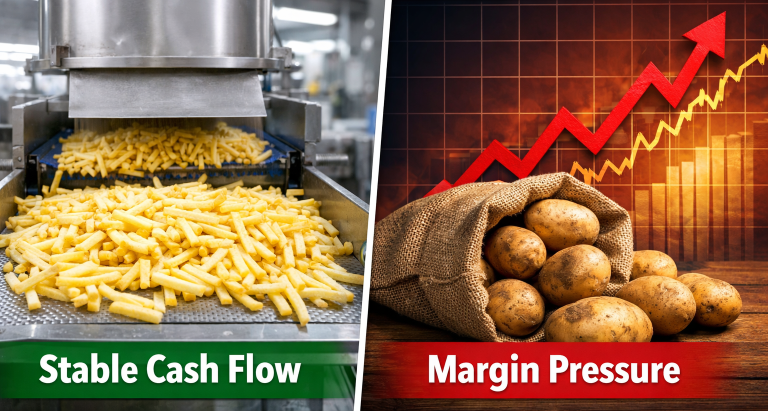
Lamb Weston is one of the world’s largest producers of frozen potato products, supplying global quick service restaurant chains, foodservice distributors, and retail grocers. Its core business revolves around value added potato processing such as french fries, wedges, and specialty appetizers sold under long term supply agreements to major restaurant brands. The firm earns revenue by transforming raw agricultural inputs into branded and private label finished products using capital intensive manufacturing facilities located near potato growing regions. Demand is relatively stable because fries are a low cost staple item within restaurant menus, though profitability can fluctuate due to agricultural input costs, logistics, and contract pricing cycles.
Investment Goal: My objective is to generate an average annual return of no less than 9% over a 16 year holding period, equivalent to roughly 300% cumulative capital appreciation. This valuation exercise is intended to determine whether this security has the financial characteristics necessary to achieve that performance threshold, and any recommendation is made under the assumption that this minimum return requirement must be satisfied.
Valuation Results
| Metric | Value |
|---|---|
| Current Price | $49 |
| DCF Intrinsic Value | $63.80 |
| MEV Intrinsic Value | $58.20 |
| Blended Intrinsic Value | $61.00 |
| Earnings Growth Used | 12.76% |
| Dividend Yield | 3.03% |
| PE | 17.38 |
| PEG | 1.36 |
| PEGY | 0.86 |
Core Investment Questions
| Question | Answer |
|---|---|
| Is the business model simple and sustainable? | Lamb Weston converts commodity potatoes into branded processed food sold via long term contracts. This is operationally simple but capital intensive and margin sensitive to input inflation. |
| List the intrinsic values, PE, PEG, and PEGY | DCF 63.80. MEV 58.20. Blended 61.00. PE 17.38. PEG 1.36. PEGY 0.86. |
| Durable competitive advantage? | Scale driven procurement advantage, plant proximity to growers, and multi year supply agreements with restaurant chains create moderate switching costs. |
| Competitors and positioning | Primary rivals include McCain Foods and J.R. Simplot Company. LW operates as one of three dominant global fry processors. |
| Management quality | Share buybacks of 4.58% suggest shareholder alignment though acquisitions have lifted leverage materially. |
| Undervalued? | Trading about 20% below blended intrinsic value. |
| Capital efficiency | ROIC 10.07% above cost of capital but leverage inflated ROE. |
| Free cash flow strength | TTM FCF of 650.80M far exceeds 5 yr average of 167.88M showing post pandemic recovery. |
| Balance sheet strength | Debt to equity 2.23 indicates leverage risk. |
| Growth consistency | 10 yr revenue CAGR above 10% indicates structural demand stability. |
| Margin of safety | Approximately 21%. |
| Biggest risks | Commodity inflation and contract repricing lag. |
| Dilution risk | Shares outstanding declined 4.58%. |
| Cyclicality | Defensive consumer staple but restaurant demand weakens in recessions. |
| 5 to 10 year outlook | Likely mid single digit volume growth plus pricing power. |
| Buy if market closed? | Yes at discount to intrinsic value. |
| PEGY meaning | Below 1 implies attractive growth plus income profile. |
| Capital reinvestment | Mix of buybacks and dividend payouts. |
| Mispricing thesis | Margin compression fears appear cyclical not structural. |
| Assumptions | Input inflation normalizes and restaurant traffic stabilizes. |
| Portfolio fit | Defensive inflation pass through consumer staple. |
| Buy hold or sell | Buy below 46 to meet 9% CAGR target. |
| Intrinsic value used | Revenue CAGR, FCF TTM, ROIC, Dividend Yield, PE |
Detailed Analysis
Business Understanding
Lamb Weston operates in the processed food manufacturing segment of the broader packaged food industry. Its economic engine is predicated on converting low margin agricultural inputs into standardized, high volume, frozen finished goods. Roughly half of global fry consumption flows through quick service restaurant chains whose menus are heavily standardized across regions. That standardization creates demand stability because french fries serve as a staple add on with extremely low price elasticity relative to entrée items. Even in periods of consumer stress, customers may trade down within menus but rarely eliminate fries entirely due to their affordability and contribution to meal bundling economics.
Revenue generation depends upon long term supply agreements with restaurant chains and institutional buyers. These contracts often contain cost pass through clauses but with lags that expose margins to short term shocks in potato prices, labor costs, freight, and energy inputs. Production is capital intensive requiring proximity to agricultural zones such as Idaho and Washington in order to minimize spoilage risk and transport cost of raw potatoes. Economies of scale become crucial because plant utilization rates directly determine margin stability.
Demand tends to be mildly cyclical rather than secularly declining. A deep recession will reduce restaurant traffic but the magnitude of decline is usually smaller than discretionary categories such as apparel or electronics. The existential risk to this model would come from dietary shifts away from fried foods or from restaurant chains vertically integrating supply. However both outcomes appear slow moving rather than imminent due to entrenched menu standardization across global franchise networks.
Competitive Advantage (Moat)
Lamb Weston’s moat is neither technological nor brand driven in the traditional consumer packaged goods sense. Instead it rests on procurement scale, logistics integration, and contractual entrenchment. The firm operates large scale processing plants located adjacent to potato farming regions. This reduces raw material transport cost relative to smaller processors and creates a cost advantage that compounds over time as volume rises.
Switching costs for major customers are operational rather than financial. A large restaurant chain standardizes fry length, oil absorption, texture, and cooking time across tens of thousands of franchise locations. Transitioning to an alternate supplier introduces risks to kitchen workflow, product consistency, and customer satisfaction. This implicit switching friction helps Lamb Weston retain long duration contracts.
Brand power exists primarily at the institutional rather than consumer level. Restaurant procurement teams prioritize reliability of supply and uniformity of product. As a result Lamb Weston competes effectively with large integrated rivals such as McCain Foods and J.R. Simplot Company by leveraging plant scale and global distribution infrastructure. The moat appears stable though not rapidly widening because competitors are similarly scaled.
Financial Strength Profitability
Revenue has compounded at roughly 12.76% annually over five years which suggests that demand growth combined with pricing adjustments has allowed the company to keep pace with input inflation. Profit margins however have compressed from a ten year average of 9.95% to a current 6.06% indicating that cost pass through has lagged commodity inflation in the short run.
Return on invested capital of 10.07% exceeds most estimates of weighted average cost of capital in the packaged food sector. This implies economic value creation despite the heavy asset base required for processing facilities. Return on equity of 22.36% appears impressive but must be contextualized against a debt to equity ratio above 2.0 which amplifies equity returns through leverage.
The persistence of profitability through multiple commodity cycles suggests that the business retains underlying resilience even when gross margin volatility emerges.
Financial Strength Balance Sheet
Liquidity metrics reveal some cause for concern. The current ratio of 1.43 falls short of the conservative threshold of 2.0 often preferred for capital intensive manufacturers. Long term leverage remains elevated as evidenced by the LTL to five year free cash flow ratio of 24.86 which implies more than two decades of average free cash generation would be required to retire long term obligations absent growth.
Enterprise value of 12.31 billion relative to earnings also indicates that a material portion of the capital structure is debt financed. While stable cash flows mitigate solvency risk, rising interest rates could pressure refinancing costs. Goodwill accumulation from acquisitions also merits monitoring in future filings.
Financial Strength Cash Flow
Free cash flow generation has improved materially in the trailing twelve months reaching 650.80 million compared to a five year average of 167.88 million. This surge reflects post pandemic normalization in restaurant demand combined with pricing adjustments embedded in supply contracts.
Capital expenditure requirements remain substantial because processing facilities must operate at high utilization to maintain margin stability. Nevertheless the improvement in cash flow suggests that recent investments are beginning to yield operating leverage benefits. Dividend coverage appears adequate with payouts representing roughly one third of free cash generation.
Margin of Safety
A blended intrinsic value estimate near 61 relative to a market price of 49 implies a discount of approximately 21%. This spread offers some protection against moderate forecasting errors though it may not suffice if commodity inflation remains structurally elevated for several years.
Mispricing Thesis
Equity markets appear to be discounting Lamb Weston due to recent margin compression and leverage expansion. However both issues may prove cyclical rather than structural. Potato costs fluctuate with harvest conditions while freight and energy expenses remain sensitive to macroeconomic variables. As supply contracts reset to incorporate higher input costs operating margins should gradually normalize.
Management Quality
The company has reduced share count by 4.58% over five years which indicates some commitment to shareholder returns. Dividend payouts totaling 206.90 million also suggest a balanced capital allocation framework. Nonetheless acquisitions totaling over 620 million during the same period have contributed to leverage expansion which must be evaluated against integration success.
Long Term Outlook
The global quick service restaurant industry continues to expand particularly in emerging markets where fries serve as a culturally adaptable side item. As restaurant footprints grow, Lamb Weston’s addressable market expands in parallel. Automation within processing plants may also enhance operating leverage over time.
Risk Assessment
Permanent capital loss could arise from sustained commodity inflation without corresponding contract repricing. Additional risks include dietary trends that stigmatize fried foods, regulatory interventions targeting trans fats, or major customer concentration within a handful of restaurant chains.
Investment Thesis
Intrinsic value near 61 implies that the market is pricing Lamb Weston as though recent margin compression is permanent. If margins revert even partially toward historical averages the equity should compound at a rate consistent with mid single digit earnings growth plus dividend yield.
Red Flag Scan Additional Items
- Customer concentration
- Input cost volatility
- Interest rate sensitivity
- Agricultural supply chain disruption
- Goodwill impairment risk
Weighted SWOT
| Factor | Weight | Rating | Weighted Score |
|---|---|---|---|
| Scale Advantage | 0.20 | 4 | 0.80 |
| Contract Stability | 0.15 | 4 | 0.60 |
| Margin Volatility | 0.20 | 2 | 0.40 |
| Leverage Risk | 0.15 | 2 | 0.30 |
| Global Demand Growth | 0.15 | 4 | 0.60 |
| Commodity Exposure | 0.15 | 2 | 0.30 |
| Total | 1.00 | 3.00 |
Scenario Intrinsic Values
- Bear Case 52
- Base Case 61
- Bull Case 74
Bear assumes sustained input inflation
Bull assumes margin reversion and contract repricing
Entry is optimal during commodity cost spikes or restaurant traffic slowdowns. Exit may coincide with peak agricultural cycles or declining global restaurant sales.
Required Entry Price for 16 Year CAGR
| Target CAGR | Buy Price |
|---|---|
| 5% | 57 |
| 6% | 53 |
| 7% | 50 |
| 8% | 48 |
| 9% | 46 |
| 10% | 43 |
Required Entry for 9% CAGR
| Holding Period | Buy Price |
|---|---|
| 5 Yr | 55 |
| 7 Yr | 52 |
| 10 Yr | 49 |
| 12 Yr | 48 |
| 14 Yr | 47 |
| 16 Yr | 46 |
Trim and Exit Levels
| Action | Price |
|---|---|
| Trim | 68 |
| Exit | 80 |
Inputs Used
- Revenue CAGR
- FCF TTM
- ROIC
- Dividend Yield
- PE
- Shares Outstanding Trend
Ignored short term moving averages and price momentum indicators.
Final Verdict
Lamb Weston represents a moderately leveraged but economically resilient participant in the global processed food supply chain. Its valuation presently embeds pessimism regarding margin durability that may prove temporary. Provided entry occurs below 46 the probability of achieving a 9% long term annualized return appears reasonable under base case assumptions. The investment therefore qualifies as a conditional buy subject to commodity cost normalization.
Disclaimer: This analysis is for informational purposes only and does not constitute investment advice. Always perform your own due diligence or consult with a financial advisor before making investment decisions.