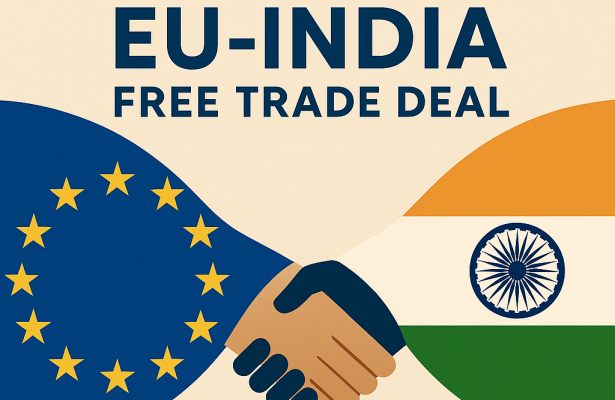
When the European Union and India concluded a sweeping free trade agreement, the deal was celebrated in Brussels and New Delhi as a milestone in global trade. It promised deeper market access, lower tariffs, and tighter integration between two of the world’s largest economic blocs. For Turkey, however, the agreement landed awkwardly. Ankara was not at the negotiating table, yet it will feel many of the consequences.
Turkey’s predicament stems from its unique relationship with the European Union. Since 1996, Turkey has been bound to the EU through a Customs Union covering industrial goods and certain processed agricultural products. This arrangement grants Turkish manufacturers tariff free access to the EU market. In return, Turkey applies the EU’s common external tariff to imports from third countries. What the Customs Union does not do is automatically extend EU free trade agreements to Turkey. When the EU signs an FTA with a third country, that country often gains improved access to Turkey’s market, while Turkish exporters do not receive reciprocal access in the partner’s market.
The EU–India Free Trade Agreement magnifies this asymmetry. It reduces or eliminates tariffs on nearly all goods traded between the EU and India. Indian exporters gain preferential access to the EU market, and once their goods enter the EU, many can circulate onward into Turkey under Customs Union rules. Turkish exporters, by contrast, continue to face India’s relatively high applied tariffs on industrial and consumer goods. The result is trade diversion rather than trade creation for Turkey, with implications that stretch across sectors, regions, and the broader macroeconomy.
This article brings together the full analysis of how the EU–India FTA affects Turkey. It examines the mechanics of trade diversion, estimates sector level losses, assesses macroeconomic spillovers, and maps winners and losers within Turkey by region. It also outlines the policy options available to Ankara as it confronts a changing trade landscape.
The Structure of the EU–India Free Trade Agreement
The EU–India agreement is broad and ambitious. It eliminates tariffs on roughly 96 percent of tariff lines by value over time, with phased reductions for sensitive sectors. Industrial goods such as machinery, chemicals, pharmaceuticals, textiles, and automotive products receive extensive liberalization. For European exporters, the deal unlocks access to one of the world’s fastest growing large markets. For Indian exporters, it opens the door to the EU’s vast consumer base.
The agreement is designed around reciprocity between the EU and India. Turkey, however, is not part of this reciprocity. As a Customs Union partner rather than an EU member, Turkey is required to align its external tariffs with the EU’s. When the EU lowers its tariffs on Indian goods, Turkey must follow suit for goods entering via the EU, even though it has no obligation to India to do so directly.
This is the structural fault line that runs through Turkey’s trade policy. It has been manageable when EU FTAs were limited or when Turkey could negotiate parallel agreements. As the EU expands its network to major economies such as India, the imbalance becomes more acute.
The Mechanics of Trade Diversion
Trade diversion occurs when preferential trade agreements shift sourcing away from more efficient producers toward those with tariff advantages. In Turkey’s case, the risk is twofold.
First, in the EU market itself, Indian producers gain a tariff advantage over Turkish exporters in sectors where Turkish goods previously competed on price. Even small tariff differentials can matter in labor intensive and price sensitive industries such as textiles and basic manufactured goods.
Second, within Turkey’s domestic market, Indian goods can enter indirectly through the EU at preferential tariff rates. Turkish producers face increased competition at home from Indian imports that benefit from scale and lower labor costs, while Turkish exporters receive no corresponding access to India.
This combination of external and internal pressure is unusual. Few countries are as deeply integrated into another bloc’s trade policy without having a seat at the negotiating table. That is why the EU–India FTA has triggered concern among Turkish manufacturers and economists.
Sector Level Impacts and Quantitative Estimates
The effects of the EU–India FTA on Turkey vary by sector. Some industries are far more exposed than others, depending on their export orientation, cost structure, and role in European supply chains. While precise forecasts are impossible, reasonable estimates can be constructed based on current trade flows, price elasticities, and historical experience with other FTAs.
Textiles and Apparel
Textiles and apparel are among Turkey’s most important export sectors. Turkey supplies the EU with clothing, fabrics, and home textiles, benefiting from proximity, short delivery times, and established relationships with European brands. Exports of textiles and apparel to the EU are estimated at roughly 13 billion euros annually.
India is one of the world’s largest textile producers, with lower average labor costs and significant economies of scale. Under the EU–India FTA, Indian textiles gain duty free access to the EU market. Even a modest shift in sourcing by European retailers could have large effects on Turkish exporters.
If 15 to 25 percent of Turkey’s textile exports to the EU were gradually displaced by Indian suppliers over a five to ten year horizon, the annual revenue loss could range from 2.0 to 3.3 billion euros. This would hit employment hard, as textiles remain labor intensive and geographically concentrated within Turkey.
Automotive and Components
Turkey’s automotive sector is deeply integrated into European value chains. It produces vehicles, engines, and a wide range of components for European manufacturers. Automotive and transport equipment exports to the EU are estimated at 30 to 35 billion euros annually.
The EU–India FTA primarily benefits European automotive exports to India by reducing tariffs that were previously very high. Indirectly, however, it also encourages tighter EU–India industrial linkages. Indian suppliers of components may find it easier to integrate into European supply chains, especially for cost sensitive parts.
If 10 percent of Turkey’s automotive related exports to the EU were substituted over time by Indian or India linked suppliers, the annual loss could reach 3.0 to 3.5 billion euros. This would not represent a collapse of the sector, but it would erode Turkey’s position at the margin and slow investment.
Machinery and Electrical Equipment
Machinery and electrical equipment are another pillar of Turkey’s export economy, accounting for an estimated 25 to 30 billion euros in exports to the EU. These goods range from industrial machinery to household appliances.
Indian tariffs on machinery were historically significant, and their elimination under the EU–India FTA gives European producers a boost in the Indian market. At the same time, Indian machinery exports to the EU become more competitive.
For Turkey, the risk lies in procurement decisions by European firms that may increasingly source from Indian suppliers for certain categories. A diversion of 5 to 15 percent of Turkish machinery exports would translate into annual losses of 1.25 to 4.5 billion euros, depending on the segment and speed of adjustment.
Chemicals and Pharmaceuticals
Chemicals and pharmaceuticals represent a smaller but still meaningful share of Turkey’s exports. Indian producers are globally competitive in generic pharmaceuticals and chemical intermediates.
With tariffs removed, Indian chemical products gain easier access to the EU and indirectly to Turkey. If 5 to 10 percent of Turkey’s chemical exports were displaced, the annual loss could range from 0.5 to 1.2 billion euros.
Aggregate Impact
Taken together, these sectoral estimates suggest potential annual trade diversion losses for Turkey of approximately 6.75 to 12.5 billion euros once the agreement is fully implemented and supply chains adjust. Even at the lower end, this represents a significant share of Turkey’s manufacturing export base and roughly 0.7 to 1.0 percent of GDP.
Macroeconomic Spillovers
The sectoral losses outlined above would not occur in isolation. They would spill over into employment, investment, and fiscal outcomes.
Employment losses would be concentrated in export oriented manufacturing, particularly textiles and automotive components. Tens of thousands of jobs could be affected over several years, with knock on effects in supporting industries.
Investment could slow as foreign and domestic firms reassess Turkey’s role in European supply chains. While Turkey would remain an attractive manufacturing base, the erosion of preferential access at the margin could tilt new investments toward other locations.
The trade balance could worsen if exports decline faster than imports, particularly if Indian goods gain market share within Turkey. Fiscal revenues from corporate taxes and value added taxes would come under pressure, though the effects would likely be gradual rather than sudden.
Winners and Losers Within Turkey by Region
The impact of the EU–India FTA will not be evenly distributed across Turkey. Regional specialization means that some areas are far more exposed than others.
Likely Losers
Marmara Region
The Marmara region, including Istanbul, Bursa, and Kocaeli, is the heart of Turkey’s industrial economy. It hosts automotive manufacturing, machinery, chemicals, and textiles. This region is highly integrated with EU markets and therefore most exposed to trade diversion.
Automotive plants in Bursa and Kocaeli could face increased competition in components. Textile producers around Istanbul and Tekirdag may lose orders to Indian suppliers. The region’s size and diversity provide some resilience, but the absolute exposure is large.
Aegean Region
The Aegean region, centered on Izmir, is another export oriented manufacturing hub, particularly for textiles, apparel, and processed goods. It also serves as a logistics gateway to Europe.
Textile and apparel firms in Denizli and surrounding provinces are especially vulnerable to Indian competition. Aegean exporters may face margin compression and pressure to move up the value chain.
Southeastern Anatolia
Southeastern Anatolia has developed a strong textile and apparel base over the past two decades, supported by lower labor costs and export incentives. Cities such as Gaziantep are major textile exporters.
These firms compete primarily on price and are therefore among the most exposed to tariff driven competition from India. Employment impacts could be particularly severe in this region, where alternative job opportunities are limited.
Mixed Outcomes
Central Anatolia
Central Anatolia, including Ankara and Konya, has a diverse industrial base with machinery, food processing, and light manufacturing. Exposure to EU markets exists but is less concentrated than in Marmara or the Aegean.
Some machinery producers may face competition, but others could benefit indirectly if European firms seek alternative suppliers within Turkey to avoid overreliance on distant sources.
Potential Relative Winners
Eastern Anatolia
Eastern Anatolia is less export oriented and less integrated into EU supply chains. While this limits growth opportunities, it also insulates the region from direct trade diversion effects.
Public investment and domestic oriented industries dominate, making the immediate impact of the EU–India FTA relatively muted.
Services Oriented Urban Centers
Large urban centers with a strong services base, including finance, logistics, and tourism, may be less affected by manufacturing trade diversion. In some cases, increased trade flows through Turkey could even support logistics and transport services.
Policy Responses Available to Turkey
Turkey is not without options. While none are easy, several policy paths could mitigate or offset the losses associated with the EU–India FTA.
Modernization of the EU–Turkey Customs Union
The most effective solution would be to modernize the Customs Union to include services, agriculture, and mechanisms for parallel inclusion in EU FTAs. This would ensure that Turkey benefits automatically when the EU signs agreements with major partners.
Such modernization would neutralize the structural asymmetry at the heart of the problem. However, it is politically difficult and depends on broader EU–Turkey relations.
A Bilateral Agreement with India
Turkey could seek a bilateral free trade agreement with India. While challenging, such an agreement could reduce tariffs on Turkish exports and partially offset trade diversion.
Even a limited agreement focused on priority sectors could unlock new opportunities in India’s growing market.
Defensive Trade Measures
In the short term, Turkey could tighten enforcement of rules of origin and monitor import surges. WTO consistent safeguard measures could be used if imports cause serious injury to domestic producers.
These tools can slow adjustment but cannot reverse the effects of tariff preferences embedded in FTAs.
Industrial Upgrading
Turkey can invest in moving up the value chain. In textiles, this means technical fabrics and branding. In automotive, it means electric vehicle components and software related systems. In machinery, it means higher value specialized equipment.
Industrial upgrading improves resilience regardless of trade policy outcomes, though it requires time and investment.
Market Diversification
Finally, Turkey can diversify export markets toward Africa, the Middle East, and Central Asia. These markets cannot fully replace the EU in scale or purchasing power, but they can reduce dependence and spread risk.
Conclusion
The EU–India Free Trade Agreement is a landmark in global trade, but for Turkey it exposes a long standing structural vulnerability. Bound to the EU through a Customs Union but excluded from its expanding network of FTAs, Turkey faces the prospect of trade diversion on a meaningful scale.
Sectoral estimates suggest potential annual losses of 6.75 to 12.5 billion euros over time, concentrated in textiles, automotive, machinery, and chemicals. The regional impact within Turkey will be uneven, with export oriented industrial regions bearing the brunt of the adjustment.
Short term defensive measures can soften the blow, and industrial upgrading can improve competitiveness. But only a fundamental rebalancing of Turkey’s trade relationship with the EU, or equivalent access to major markets such as India, can fully address the underlying problem. Without such changes, Turkey risks a gradual erosion of its industrial export base, even as global trade continues to realign around large preferential blocs.