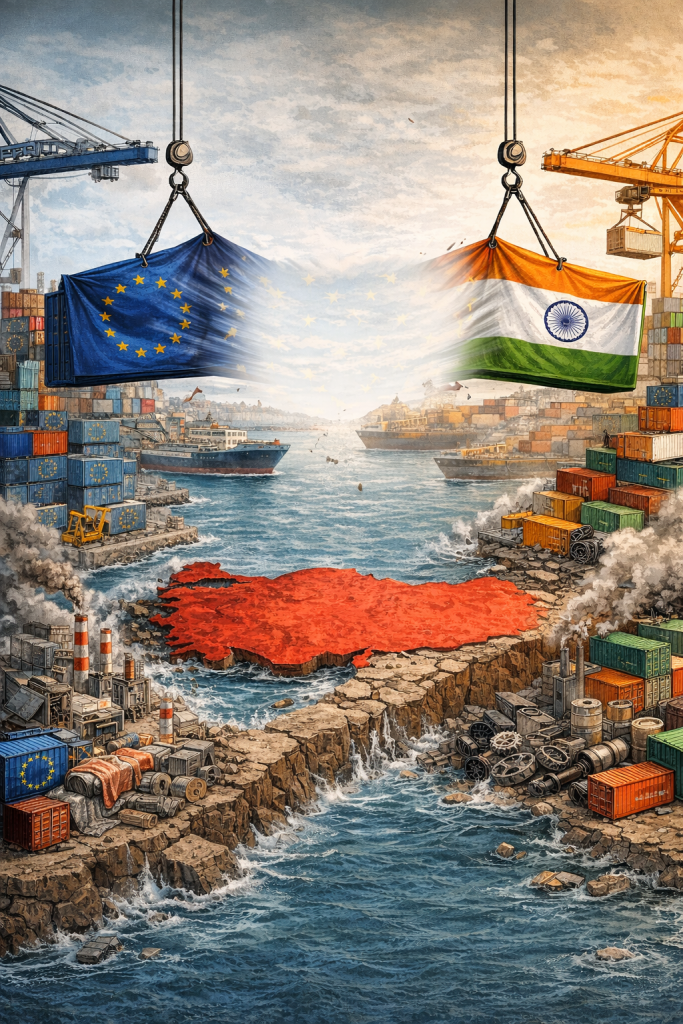
The European Union and the Republic of India have signed a long-anticipated Free Trade Agreement, widely described by leaders on both sides as a landmark economic and strategic milestone. The pact comes after nearly two decades of intermittent negotiations and was concluded in January 2026 during high-profile diplomatic engagement between the partners.
At its core, the deal will dramatically reduce or eliminate tariffs on the vast majority of goods and services traded between the EU and India, creating seamless access across a market of roughly 2 billion people and close to 25 percent of global GDP.
Key commercial features include:
- Tariff liberalisation: India will reduce tariffs on approximately 96.6 percent of EU goods by value, with the EU reciprocating on nearly 99.5 percent of Indian goods over a transitional period of several years.
- Market access: European exporters will save an estimated €4 billion annually in duties, improving competitiveness in sectors such as machinery, aerospace equipment, chemicals, pharmaceuticals, and vehicles.
- Automobiles and vehicles: India will cut duties on high-end passenger cars from very high rates down to much lower percentages under phased rules and quotas, including differentiated treatment for electric vehicles to protect domestic nascent EV producers.
- Trade in services: Beyond goods, the pact envisions improved access to services sectors, including financial, maritime, professional, IT, and telecommunications, easing regulatory barriers for firms operating across borders.
- Customs, standards, digital trade and investment protection: The agreement also includes provisions on customs simplification, intellectual property protections, digital trade commitments, and dispute resolution frameworks.
Negotiations explicitly carve out sensitive agricultural products and sectors such as dairy where domestic producers on both sides sought protection.
In geopolitical terms, the FTA represents a strategic realignment in global commerce. Amid rising trade tensions with the United States and concerns over supply chain resilience, both the EU and India have prioritised deepening economic ties. European Commission leadership has hailed it as one of the most ambitious trade deals in recent times, and Indian ministers describe it as a defining achievement in global trade diplomacy.
What the Deal Means for Each EU Member State
The European Union’s 27 member states will be affected differently owing to their industrial specialisations, trade profiles, and economic structures. This section summarises likely impacts by broad grouping and key national interests:
Germany
Germany’s export-oriented manufacturing base stands to gain substantially. Reduced tariffs on machinery, automotive parts, and industrial equipment will lower the cost of accessing India’s fast-growing market. Premium German automobiles from brands like BMW, Mercedes-Benz, and Volkswagen will benefit from phased tariff reductions, though quotas initially apply. A broader Indian market for capital goods could help support Germany’s industrial clusters.
France
France will enjoy expanded market access for aerospace, luxury wines and spirits, cosmetics, and agri-food products thanks to tariff reductions. The deal’s provisions on geographical indications protecting names such as Champagne and Cognac matter for French exports. Services firms, including financial and professional services, could see easier entry into India’s growing economy.
Italy
Italy’s agri-food, fashion, and industrial machinery sectors are well positioned to benefit from lower duties. Luxury garments, footwear, and artisanal foods increasingly find buyers in India’s rising middle class. Italy’s industrial export chain in machinery and components will see improved competitiveness as customs costs fall.
Spain
Spanish exports of food products (e.g., olive oil), machinery, and pharmaceuticals should face fewer duties, enhancing price competitiveness. Services particularly tourism, education, and transport could see expanded access under liberalized service provisions. Spain’s smaller industrial base means gains will be more concentrated in niche sectors.
Netherlands
The Netherlands, a logistics and trade hub, will benefit indirectly through increased transit trade and distribution of EU goods to India. Dutch services in logistics, freight, and business services are poised for stronger integration. Agriculture and horticulture, including flowers and processed goods, will enjoy tariff relief in Indian markets.
Belgium
Belgian chemical and pharmaceutical exports will be more competitive with tariff cuts. The EU’s broad network including Belgium’s port infrastructure can help channel goods to India more cost-efficiently, reinforcing Belgium’s role as a distribution center.
Poland
Poland’s machinery, automotive component, and chemical sectors will see improved access. As a growing exporter of capital goods within the EU, Poland can expand production for Indian partners. Agricultural exemptions limit some gains, but intermediate inputs could see demand growth.
Sweden, Finland, and Denmark
Nordic firms in telecommunications, IT services, and specialised manufacturing will gain improved Indian access. Danish and Swedish industrial equipment and environmental technology exports could see new opportunities as India emphasises infrastructure and sustainability.
Eastern EU States (e.g., Hungary, Czech Republic, Slovakia, Romania)
These states are export producers in automotive parts, machinery, and chemicals. Tariff cuts will make their exports more price competitive. Services sectors focused on engineering, software, and consulting may also find new Indian partners.
Southern EU Members (Greece, Portugal)
Southern states will see gains in niche agricultural products, speciality foods, and tourism services. Greece’s knack for shipping and logistics positions it well in increased EU-India trade flows.
Across the EU, service industries will benefit from clearer market access and reduced regulatory barriers, though outcomes depend on domestic regulatory alignment and professional mobility frameworks. The agreement’s full benefits will hinge on ratification by each EU parliament and implementation in national law.
What the Deal Means for Every Indian State
Economic effects within India will vary by industrial profile, export orientation, and labour intensity. Below is a detailed map of likely impacts by state, grouped by economic structure.
Gujarat
Gujarat’s export-oriented economy, anchored in textiles, chemicals, petrochemicals, gems, and diamonds, stands to gain robustly. Labour-intensive textiles and leather goods enjoy tariff removal in the EU, enhancing competitiveness relative to Bangladesh and Pakistan. Gujarat’s ports will see increased throughput.
Maharashtra
Maharashtra, home to Mumbai’s financial services and Pune’s manufacturing, will see export growth in pharmaceuticals, automotive components, IT services and processed foods. The state’s hubs for chemicals and machinery can expand EU market share.
Tamil Nadu
Tamil Nadu’s cluster in automobiles, textiles, leather, and chemicals will see new demand. Textile exports from Tiruppur knitwear to Coimbatore fabrics will enter the EU duty-free, supporting jobs in labor-intensive mill towns.
Karnataka
Karnataka’s information technology and biotechnology sectors will gain access to EU service markets and deep research collaborations. Bangalore’s high-tech base can leverage reduced barriers for software, digital services and R and D partnerships.
Delhi NCR
As an administrative and services hub, Delhi NCR will benefit from expanded consultancy, finance, education and professional services exports. Logistics and trade intermediaries will see increased activity supporting larger export flows.
Uttar Pradesh
Uttar Pradesh’s leather, footwear, handicrafts and agri-processing clusters will benefit. Zero or reduced tariffs on leather products into the EU help traditional artisan sectors around Kanpur and Agra.
West Bengal
Shipbuilding, jute products, tea, gems and jewellery clusters can expand exports. Reduced tariffs on processed tea and handicrafts will support West Bengal’s export competitiveness.
Rajasthan
Rajasthan’s gems and jewellery producers are poised for export growth under zero duty access. Textile handlooms and leather products from Jaipur and Barmer also stand to benefit.
Andhra Pradesh and Telangana
Pharmaceutical units in Hyderabad and agriprocessing industries in Andhra Pradesh will find more favourable EU access. IT services from Hyderabad will also move into broader European engagements.
Kerala
Cashew, spices, coir and marine products will be lifted by tariff cuts, helping Kerala’s traditional exports. Service exports in tourism and wellness can also tap European clients with eased regulations.
Punjab
Punjab’s agro-processing units and textiles will find incremental access, though agriculture remains sensitive and not fully liberalised. Value-added processed foods may see gains.
Smaller States
States with nascent manufacturing or services sectors such as Himachal Pradesh, Odisha and the North East will benefit from scaled supply chain engagement, though impacts depend on local connectivity and export readiness.
Across India, services sectors including IT, digital services, transport, logistics and professional services will benefit from clearer access and regulatory alignment, helping India develop higher value economic activities.
Strategic and Economic Implications
The EU-India FTA stands as a strategic pivot in global trade. It signals confidence in multilateral trade liberalisation even as unilateral tariffs rise elsewhere. It reinforces bilateral ties, diversifies supply chains away from reliance on a single market, and promotes investment flows in technology, infrastructure and manufacturing.
The pact will not be transformational overnight, but incremental integration over years is expected to reshape production networks, consumer prices and export trajectories on both sides. It also sets a template for future agreements with economies such as ASEAN, South America or GCC countries.
Implementation and Timing
The deal must still be ratified by the European Parliament and individual EU member states, as well as approved by India’s Parliament, before it takes effect. Formal implementation is expected in 2027, with tariff reductions and market access rules phased in over several years.
Conclusion
India’s has a population of 1.45 billion, of which 450 million are middle class consumers and potential customers for European products. Europe has a GDP of 3.91 and 449 million potential customers for Indian products. Once and if passed by European and Indian parliaments, this deal will lower trade barriers between two regions with a population close to 2 billion. The positive and negative effects of this deal will material over many years as different industries and businesses pivot themselves to take advantage of the provisions of the deal.